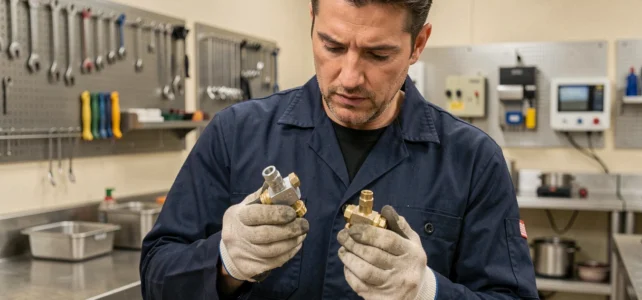
A nozzle is a small brass piece with a calibrated orifice that regulates the flow of gas to the burner. Its diameter changes depending on the type of gas used, because natural gas (town gas) and bottled gases (butane, propane) do not reach the burner at the same pressure. Installing the wrong nozzle can cause a flame that is too high, too low, or incomplete combustion that releases carbon monoxide.
Pressure and calorific value: why the nozzle diameter changes
The natural gas distributed by the network flows at a pressure of about 20 mbar. Butane and propane in bottles arrive at a significantly higher pressure, around 28 to 37 mbar depending on the gas and the regulator. This pressure difference explains everything else.
At lower pressure, a wider orifice is needed to allow enough gas to pass through and reach the nominal power of the burner. At higher pressure, a smaller orifice is sufficient, and a hole that is too large would cause a dangerous excess of gas. The calorific value also comes into play: propane and butane release more energy per unit of volume than natural gas, which reinforces the need for a reduced orifice.
Understanding the differences between town gas and bottled gas nozzles helps avoid a mounting error with serious consequences for safety and cooking performance.
G20 and G30/G31 nozzles: identification and correspondences
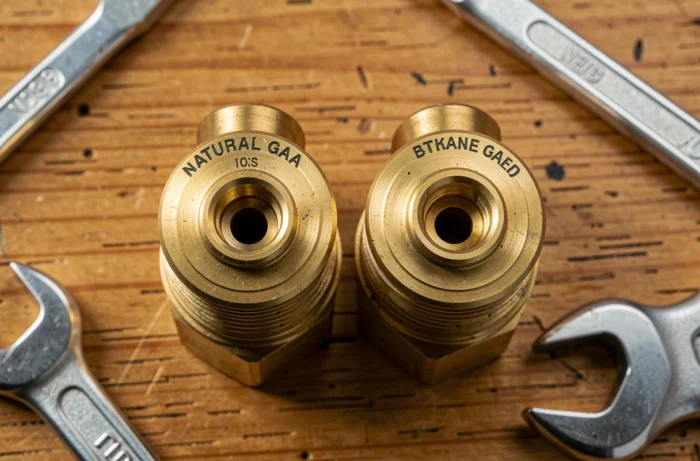
Each nozzle bears a standardized marking indicating the compatible gas type. G20 nozzles are intended for natural gas (town gas). G30 nozzles correspond to butane, and G31 to propane. In practice, for bottled gas, manufacturers often provide a single set compatible with G30/G31.
The engraved mark on the nozzle (a number in hundredths of a millimeter) indicates the orifice diameter. The higher the number, the wider the hole. For the same burner, the mark of a G20 nozzle is always higher than that of a G30/G31 nozzle.
Correspondence by burner type
The manual for each appliance contains a table of injectors that associates each burner (auxiliary, semi-rapid, rapid, oven) with a specific mark. The values vary from one manufacturer to another, but the logic remains constant:
- An auxiliary burner uses the smallest nozzles, for example, a mark around 50 to 70 in G20 and 24 to 50 in G30/G31.
- A rapid burner reaches significantly higher marks in G20 (up to 129) while G30/G31 remains lower (up to about 87).
- The oven burner follows the same principle, with G20 marks reaching 135 compared to 90 in G30/G31.
These values are indicative. The only reliable reference remains the table in your stove or cooktop manual.
Changing nozzles when converting from natural gas to bottled gas
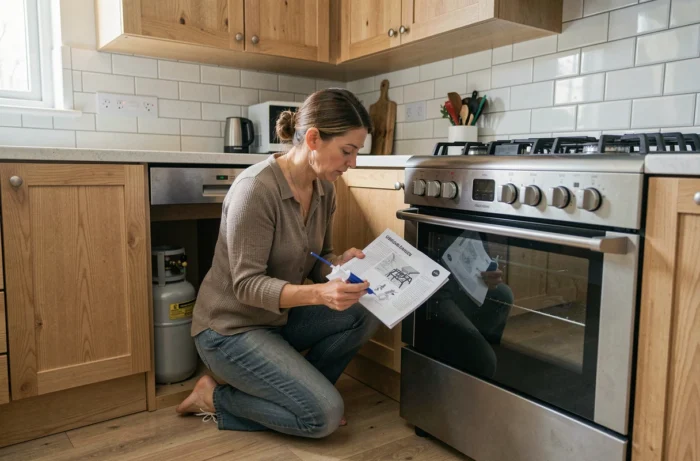
A move or a change in supply sometimes requires converting an appliance designed for town gas to propane or butane, or vice versa. Most recent cooking appliances come with a bag of replacement nozzles suitable for the other type of gas.
The concrete steps of conversion
Remove the burner caps and crowns to access the nozzles. Each nozzle is unscrewed with a tube wrench of the correct size. It is replaced with the nozzle corresponding to the new gas, checking the engraved mark before screwing it in. The adjustment of the minimum air flow (bypass screw) must be adjusted after the change, otherwise the low flame will be unstable or extinguish.
For the oven, access to the nozzle is generally from the bottom of the cavity or under the base, depending on the model. Some ovens require removing the back panel.
Conversion label: a traceability obligation
Start-up guides now require sticking a label on the back of the appliance after any conversion, indicating the date and type of gas installed. This label is used during gas diagnostics, periodic checks, or service interventions. An appliance converted without a label may pose problems during a compliance check.
Universal injectors or original nozzles: which kit to buy
Two options are available when purchasing replacement nozzles. The manufacturer’s original nozzles guarantee perfect compatibility with the appliance, but they often cost more and can sometimes be difficult to find for older models.
Universal injectors fit most gas stoves and cooktops. They come in kits covering butane, propane, or natural gas. Their standard threading is suitable for most brands, but some appliances may use a specific thread.
- Check the threading (usually M6 or M7) in the manual before ordering a universal kit.
- Prefer kits that come with a conversion manual and a traceability label.
- If in doubt about compatibility, the model number engraved on the appliance’s nameplate allows you to find the injector table from the manufacturer.
Manufacturer kits increasingly include all the necessary elements for a documented conversion, simplifying the process in case of later checks.
The choice of the right nozzle depends on three data points: the type of gas (G20, G30, or G31), the mark indicated in the manual table, and the threading of the appliance. Every conversion must be documented with a dated label, a detail that many users overlook and which complicates subsequent maintenance interventions.