
A hair that lacks thickness at the temples, a haircut that no longer holds like before, the desire for a longer style without waiting months for regrowth: hair extensions for men address very concrete situations. Far from the feminine cliché, this practice is aimed at all male profiles, whether to densify a sparse area or to radically change hairstyles.
Breathable bases and scalp comfort: the criteria that guides overlook
Have you ever worn a cap all day in summer? The scalp overheats, sweats, and becomes irritated. The same problem arises with certain extensions or hair systems if the base resting on the skull is not suitable.
Recent market analyses on men’s hair systems indicate a shift towards breathable lace and mesh bases. Users are turning away from solid polymer bases, which trap heat, in favor of materials like Swiss lace. This ultra-fine fabric allows air to pass through and reduces the risk of long-term irritation.
For an active man (sports, travel, long days), this choice conditions daily comfort as much as visual appearance. A breathable base dries faster after a shower and limits bacterial proliferation on the scalp.
If you want to delve deeper into the subject, hair extensions for men are detailed with the different options available in the current market.
Natural or synthetic hair: how to choose your strands
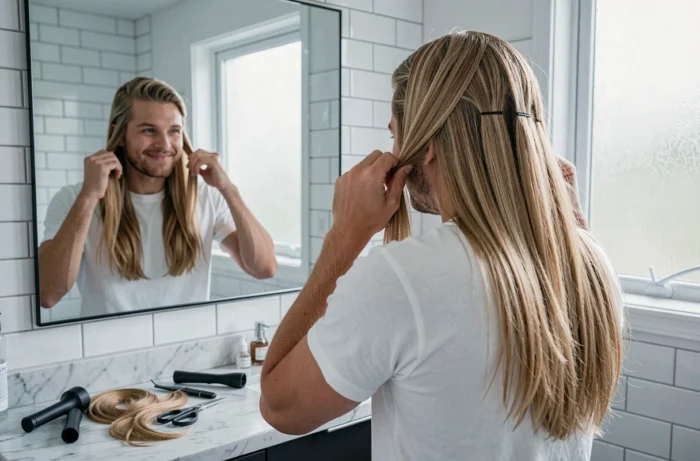
The choice between natural hair extensions and synthetic extensions determines lifespan, appearance, and maintenance. Here’s what distinguishes them concretely.
Natural hair extensions
Natural strands (often of Indian origin, sourced from temples) behave like your own hair. They can be washed, blow-dried, and styled with a curling iron. Their texture blends with the existing hair, making them almost undetectable to the touch.
The downside: their cost is significantly higher. They also require regular maintenance with suitable products, similar to those used for classic long hair.
Synthetic extensions
Cheaper, synthetic strands retain their initial shape (straight, wavy, curly) effortlessly. However, they do not handle heat well. A pass with a straightening iron can damage them permanently.
For occasional use or a first trial, synthetic is sufficient. For daily wear over several weeks, natural hair remains the benchmark in terms of quality and longevity.
Application techniques suited to men’s haircuts
Attachment methods vary depending on the existing length, the area to be covered, and the desired result. Three techniques dominate among men.
- Keratine (hot application): each strand is attached at the root with a melted keratin capsule. The result lasts several weeks and withstands daily shampoos. This method is suitable for men who want to keep their extensions for a long time without frequent touch-ups.
- Clips (temporary application): the strands are attached with small clips directly onto the hair. They are removed in the evening. This is the simplest solution to test a look or add volume for an event.
- Glued or integrated systems (type “second skin”): an ultra-fine base, often in lace, is fixed on the scalp. The implantation of the hair in a V-loop mimics the natural growth angle, making the hairline undetectable, even in high definition.
Why does this last point matter? Men exposed to video or social media seek an invisible result on camera. The V-loop implantation on an ultra-fine base meets this requirement for absolute discretion.

Maintenance of men’s extensions: the actions that change lifespan
Applying extensions represents only half the work. Maintenance determines how long the result remains clean and natural.
First reflex: adjust the shampoo. Products containing harsh sulfates weaken the attachment points (keratin, glue). A gentle, sulfate-free shampoo prolongs the hold by several weeks. The same principle applies to conditioner, which should be applied to the lengths without touching the roots or the capsules.
The second often overlooked point: drying. Never rub the extensions with a towel. Gently pat them dry, then let them air dry or use a hairdryer on a warm setting. Excessive heat detaches the attachments and dries out the natural strands.
The third concrete action: detangle with a wide-toothed comb, starting from the tips and gradually moving up to the roots. Pulling from the top breaks the strands and pulls out the attachment points.
Color and length: finding the right balance for a masculine appearance
The color of the extensions should match the exact shade of your hair. A half-tone difference is enough to make the addition visible, especially in natural light. Specialized salons usually offer a color chart to match the color before application.
Regarding length, the practical rule is simple: do not exceed double the current length in a single application. Going from a very short cut to medium-length hair all at once produces an artificial result. It’s better to proceed in stages, adding a few centimeters at each session, so that those around you perceive a natural evolution.
Volume also plays a role. Adding too many strands to fine hair creates an imbalance between the roots (flat) and the lengths (thick). An experienced hairdresser adjusts the number of strands to the existing hair density to avoid that “helmet” effect.
The market for men’s extensions is evolving rapidly, driven by finer materials and less visible application techniques. The choice of base, hair type, and attachment method conditions both comfort, appearance, and durability. Taking the time to test a temporary method (clips) before investing in a semi-permanent application remains the most reasonable approach for a first trial.