
When looking for where to submit a building permit, how to get around without a car, or to whom to report a leak in the water network, the answer often leads to the same structure: Guingamp-Paimpol Agglomeration. This community of municipalities, nestled between Armor and Argoat in Côtes-d’Armor, concentrates skills that touch the daily lives of every resident in the Breton territory.
Digital Urban Planning Counter: submit a file without going to the town hall
Before digitization, preparing a building permit or preliminary declaration involved back-and-forth trips to the town hall, paper forms, and delays in transmission between services. Guingamp-Paimpol Agglomeration has set up a Digital Urban Planning Authorization Counter (GNAU) that allows online submission of urban planning certificates, preliminary declarations, building, development, or demolition permits.
In practice, you fill out the form from home, attach the documents in digital format, and the follow-up is done online. All information related to these procedures and the other skills of the agglomeration is gathered on https://www.cc-guingamp.fr/, which remains the entry point for project holders as well as individuals.
For the rural municipalities in the territory, where town hall secretariats are only open a few hours a week, this counter changes the game. No need to schedule an appointment: submissions can be made at any time.
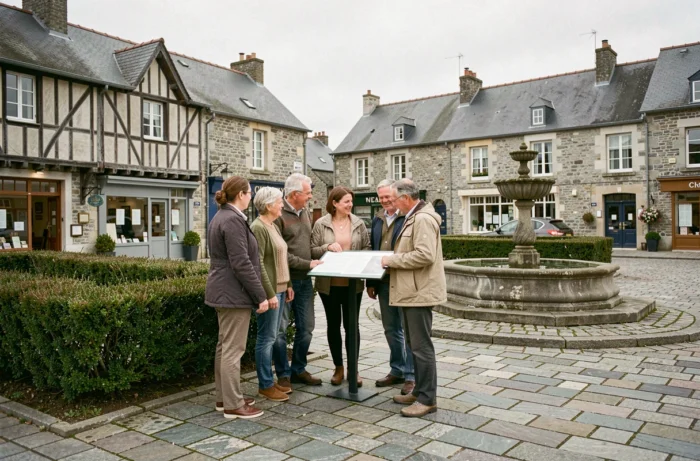
Guingamp-Paimpol Mobility Transport Network: buses, demand, and school transport
Since March 2023, the public transport network has been named Guingamp-Paimpol Mobility. The service is structured around three pillars: urban bus lines Axéo, demand-responsive transport Axéo Bus+, and a service dedicated to people with reduced mobility. The school transport aspect is covered by Axéo scolaire.
What has changed recently is the funding. Starting July 1, 2024, a mobility contribution rate of 0.50% has been established or updated in several municipalities of the agglomeration, including Bégard, Belle-Isle-en-Terre, Bourbriac, and Callac. This contribution, collected from employers, reflects an increase in funding for mobility in a territory where individual cars remain dominant.
Demand-responsive transport: a response to low-density areas
In areas far from regular lines, Axéo Bus+ operates on a reservation basis. You call or book online, and a vehicle comes to pick up the user at a nearby stop. Feedback on this point varies by municipality, but the principle remains the same: to avoid isolating residents without a fixed line.
- Axéo: regular lines in the urban area around Guingamp and Paimpol
- Axéo Bus+: demand-responsive transport in rural areas, by reservation
- Axéo scolaire: transport service for students in the territory
Water management and drought in Côtes-d’Armor: a pressured responsibility
Water is probably the most visible inter-municipal responsibility when things get complicated. During periods of drought, it is the agglomeration’s services that manage restrictions, communicate on resource levels, and coordinate measures with the prefecture.
Recently, a large part of the municipalities of Guingamp-Paimpol Agglomeration has been placed in a drought crisis situation, with historically low water resource levels. The situation has led to usage restrictions for residents and agricultural operators in the territory.
Water network works in Guingamp
Alongside the drought episodes, pipeline renewal projects have been launched in several streets of Guingamp. These works, which span several weeks, may lead to occasional water outages. The agglomeration ensures project management and communication with the affected residents.
The management of drinking water and sanitation at the inter-municipal level allows for the pooling of investments in infrastructures that isolated municipalities would not have the means to finance alone. It is a concrete lever for maintaining service quality in Brittany.
Economic development and employment in the Guingamp territory
The agglomeration is involved in the creation and management of activity zones (industrial, commercial, artisanal, tourist), supporting local commerce and promoting tourism. It also manages tourist offices within the inter-municipal perimeter.
A concrete example: a local association has generated nearly 3,000 jobs in the Guingamp territory by supporting project holders and businesses in the creation or development phase. This type of initiative falls under the economic development responsibility carried by the agglomeration.
- Creation and management of activity zones: industrial, commercial, artisanal, port
- Local commerce policy and support for community-interest commercial activities
- Promotion of tourism and management of the territory’s tourist offices
- Support for project holders through the associative fabric and inter-municipal mechanisms
Housing and social housing
The agglomeration carries a local housing program that covers social housing policy, financial aid, and land reserves. In a territory where real estate pressure remains moderate compared to the Breton coastline, the challenge is to maintain an accessible housing supply to retain residents and attract new households.
The inter-municipality also manages the local urban planning plan at the community level, the territorial coherence scheme, and community-interest development operations. These planning tools determine what can be built, where, and at what pace.
Between water management, mobility, digitized urban planning, and economic support, the scope of action of Guingamp-Paimpol Agglomeration far exceeds simple administrative coordination. For the residents of the municipalities between Armor and Argoat, it is the structure that keeps daily services running, including those that are only noticed when they stop.