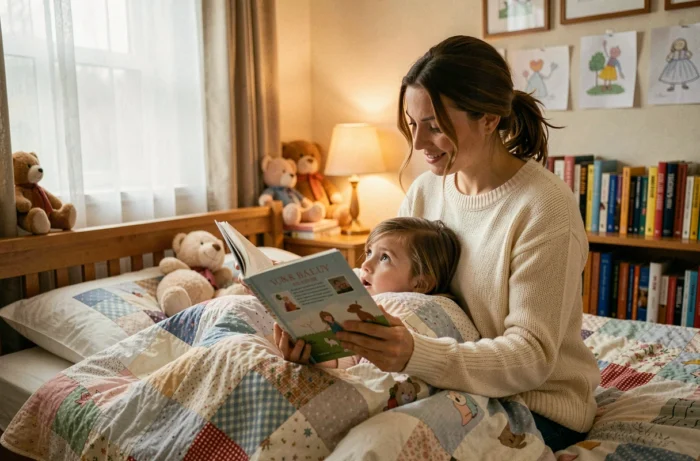
Bedtime stories hold a special place in the daily lives of families. Their effect on children goes beyond simple narrative pleasure: a longitudinal study from May 2024 and a meta-analysis published in 2025 show that regular exposure to structured stories helps prepare for independent reading and understanding complex texts. What types of narratives produce the best effects depending on age, format, and the goals sought by parents?
Interactive reading and emotional regulation: what recent research measures
Most selections of children’s stories focus on narrative content. The rarely addressed angle concerns how the story is shared and its measurable impact on emotional development.
A study by Zhu et al. (2026), conducted with 334 preschool children, establishes a direct link between the ability to verbalize emotions and the speed of recovery after a distressing episode. On days when the child puts more words to what they feel, they recover more quickly from a significant sorrow.
Stories read interactively (asking questions, revisiting what a character feels) strengthen this skill. Children then reuse the coping strategies observed in the narrative. A parent who asks, “Why is the character afraid?” transforms a simple bedtime story into a tool for emotional regulation, without the child perceiving any exercise.
Several online catalogs gather stories designed for this type of shared reading, such as the resource available at https://histoire-enfant.fr/, which offers stories categorized by theme and age.
Bedtime stories by age group: comparative table of suitable formats
The ideal format for a bedtime story varies according to the child’s age. The table below summarizes the most relevant formats based on developmental stage, cross-referencing recommendations from specialized sources.
| Age Group | Recommended Format | Indicative Duration | Main Objective |
|---|---|---|---|
| 1-3 years | Board books, repetitive nursery rhymes | Few minutes | Sensory ritual, emotional security |
| 3-6 years | Short illustrated tales, audio stories | 5 to 10 minutes | Emotional vocabulary, imagination |
| 6-9 years | Chapter stories, traditional tales | 10 to 15 minutes | Narrative comprehension, literacy |
| 9-12 years | Short novels, gentle suspense stories | 15 to 20 minutes | Independent reading, moral reflection |
The most marked gap is between 1-3 years and 3-6 years. Before three years, content matters less than repetition and voice. The child becomes attached to the rhythm, prosody, and the return of the same story each night. From the age of three, narrative variety becomes a lever for developing emotional vocabulary, as confirmed by the study by Zhu et al.
Traditional tales or contemporary stories: different effects on sleep
Parents often hesitate between classics (Perrault, Grimm, Andersen) and modern narratives designed for bedtime. These two categories do not serve the same function.
Traditional tales mobilize universal narrative patterns: a hero, a challenge, a resolution. This predictable structure reassures, but some narratives contain anxiety-inducing elements (wolf, abandonment, darkness) that can produce the opposite effect in a child sensitive to the fear of the dark or separation anxieties.
Contemporary bedtime stories take a different approach. They intentionally reduce narrative tension and incorporate relaxation elements: sensory descriptions, slowing down the pace, characters who gradually fall asleep. The Calm website, for example, structures its children’s stories around a gradual descent into calm.
In contrast, classical tales develop a better understanding of complex narrative structures. A six-year-old following the adventures of Little Thumb exercises their sequential memory and ability to anticipate a resolution, skills directly linked to literacy.

Criteria for choosing between the two approaches
- If the child has trouble falling asleep or anxiety at bedtime, prioritize contemporary stories with low narrative tension, featuring soothing characters and a quick resolution
- If the child falls asleep easily and requests adventures, traditional tales (suitable for their age) enrich their narrative repertoire and vocabulary
- Alternating the two formats from week to week allows for combining benefits: emotional regulation on one side, cognitive development on the other
Audio stories or parental reading: impact on the quality of the evening ritual
Podcasts and audio story applications for children have multiplied in recent years. The question of their effectiveness compared to parental reading deserves to be asked without dogmatism.
Interactive reading by a parent remains the most effective format for developing emotional verbalization. The adult adjusts their voice, pauses, asks questions, and rephrases. This dialogue around the narrative is precisely what the study by Zhu et al. identifies as a driver of emotional regulation.
Audio stories present a different advantage: they offer autonomy to the child and allow the ritual to be maintained even when the parent is unavailable. For children from the age of six, listening to a story in the dark promotes the construction of mental images, as the visual support disappears.
- Parental reading is better suited for children under six, for whom physical contact and verbal exchange are integral parts of the bedtime ritual
- Audio works well as a complement from the age of six, especially for children who already read alone but still enjoy external narration
- Both formats lose effectiveness if the screen remains on: blue light delays melatonin production and contradicts the goal of falling asleep
The choice of format matters less than consistency. A story ritual maintained every night, regardless of the medium, establishes a transition signal towards the night that the child gradually internalizes. Families that alternate parental reading during the week and audio on weekends retain the benefits of both approaches without turning bedtime into a chore.