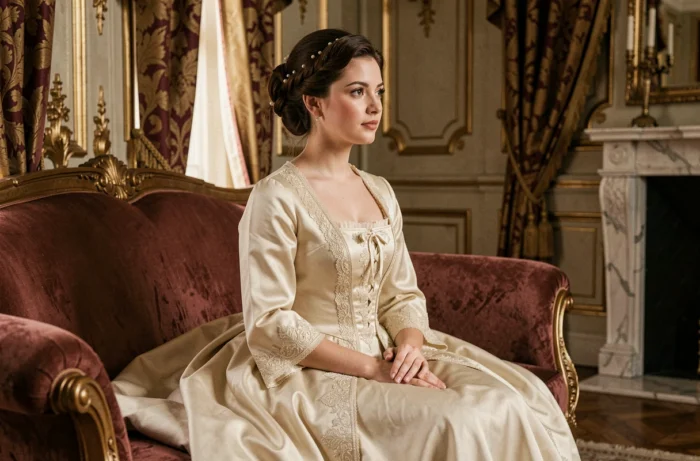
Marie-Valérie of Austria is the fourth and last child of Emperor Franz Joseph I and Empress Elisabeth of Bavaria, born on April 22, 1868, in Budapest. Archduchess of the House of Habsburg-Lorraine, she holds a unique place in dynastic history: that of the only child truly raised by Sissi herself, in a context where the three older siblings had been entrusted to Archduchess Sophie, the empress’s mother-in-law.
Marie-Valérie’s Diaries: An Underutilized Historical Source in French
Most of the available online accounts repeat the same anecdotes about Sissi’s favorite daughter. What is less known is that Marie-Valérie left a considerable corpus of personal writings, diaries, and correspondence, which constitute a primary source on the daily life of the Austro-Hungarian imperial family.
These texts remain largely unpublished in French. German-speaking research and, to a lesser extent, Slovak research continue to actively exploit this material. A recent study focused on the psychological portrait of Marie-Valérie through her writings confirms that her diaries illuminate family dynamics well beyond the romantic myth.
This editorial asymmetry partly explains why the story of Marie-Valérie of Austria remains simplified in the Francophone space, reduced to a few conventional episodes while the intimate material offers a much more nuanced picture.
Marie-Valérie and Hungary: Between Political Symbol and Personal Guilt
Marie-Valérie’s birth in Budapest is not insignificant. Empress Elisabeth, passionately attached to Hungary, wanted her last daughter to be born on Hungarian soil, shortly after the Austro-Hungarian Compromise of 1867. The very name of the child, “Valérie,” sparked controversy at the Viennese court, where a name more in line with Habsburg traditions would have been preferred.
Marie-Valérie was perceived as a “child offered to Hungary”, a symbolic gesture from her mother towards the kingdom she cherished. This political dimension weighed on the archduchess throughout her life.
Recent studies of her writings reveal a lasting inner conflict. Marie-Valérie describes herself as torn between her role as a miracle child, emblematic of the bond between Sissi and Hungary, and a sense of guilt towards her siblings. She perceived maternal favoritism and measured its cost on her relationships with her brother Rudolf and her sister Gisela.
Love Marriage with Franz Salvator of Habsburg-Tuscany
In a dynasty where unions were negotiated according to diplomatic imperatives, Marie-Valérie obtained a rare privilege: to marry the man of her choice. She married Archduke Franz Salvator of Habsburg-Tuscany, a prince from the Tuscan branch of the family, in a ceremony in Bad Ischl.
Empress Elisabeth supported this love marriage, granting her daughter the emotional freedom she had not known herself. Franz Joseph, despite initial reservations related to Franz Salvator’s relatively modest rank within the Habsburg family, ultimately gave his consent.
The couple settled at Wallsee Castle in Lower Austria, far from the splendor of the Viennese court. Marie-Valérie led a deliberately withdrawn existence there, devoted to her large family and local charitable works. This choice of withdrawal contrasts with the tragic fate of other members of the dynasty.
A Prolific Family Life at Wallsee
The couple had several children, perpetuating the Habsburg-Tuscany branch. Marie-Valérie invested in their education with an attention that contemporaries deemed unusual for an archduchess. Her nickname, “the Angel of Wallsee,” reflects her charitable commitment to the local population.
Sissi and Marie-Valérie: A Mother-Daughter Relationship Marked by Anxiety
The bond between Elisabeth and her youngest daughter goes beyond mere maternal favoritism. Marie-Valérie’s diaries document an intense, sometimes suffocating relationship in which the archduchess played the role of confidante and emotional support for her mother.
Marie-Valérie notes in her writings that her mother caused her great anxiety and that life seemed joyless to Sissi. This observation, made years before the empress’s assassination in 1898, reflects an early insight into Elisabeth’s psychological state.
Several elements emerge from this relationship documented by intimate writings:
- Marie-Valérie served as a mediator between her parents, whose marriage had gradually distanced over the decades
- The empress projected emotional expectations onto her youngest daughter that the rest of the family did not fulfill, creating a form of reversed emotional dependency
- After Sissi’s assassination in Geneva, Marie-Valérie became the main support for the aging Franz Joseph, extending her role as a family pillar
End of Life and Memory of the Archduchess of Austria
Marie-Valérie of Austria passed away in 1924 at Wallsee, at the age of 56. She lived through the end of the Austro-Hungarian Empire, World War I, and the proclamation of the Republic of Austria without ever leaving her retreat in Lower Austria.
Her death went almost unnoticed in a redrawn Europe where the House of Habsburg-Lorraine had lost all political power. The family’s assets were partly confiscated after 1918, and Wallsee Castle changed status.
The memory of Marie-Valérie remains largely overshadowed by that of her mother today. The primary sources she left behind, diaries and correspondence, are still awaiting a complete critical edition in the French language. This material would allow for a departure from the conventional image of the “favorite daughter” to restore the portrait of a cultured woman, aware of the contradictions of her rank and clear-eyed about the fragilities of her own family.