
A strike at DHL is never just a simple delay in parcel delivery. It reveals the structural fragilities of a logistics network that handles millions of shipments daily, where every blocked sorting node propagates cascading delays throughout the entire chain, from express freight to e-commerce deliveries.
Propagation Mechanism of a DHL Strike on the Sorting Network
The DHL network operates on a hub-and-spoke model: parcels pass through central platforms before being redistributed to local agencies. When a social movement blocks one of these hubs, it is not just the affected geographical area that experiences delays.
Shipments in transit, whether domestic or international, become immobilized in saturated warehouses. We systematically observe a domino effect on secondary sorting platforms, which receive abnormal volumes once the conflict is over.
The December 2024 strike in France illustrated this phenomenon: thousands of parcels were left waiting at the blocked sites, and management had to promise delivery “as soon as possible” without being able to guarantee a precise date. To better understand the consequences of the DHL strike, it is essential to distinguish between domestic flows and international flows, as the recovery mechanisms differ radically.
Within French territory, recovery relies on mobilizing additional teams and using subcontractors. Internationally, rescheduling depends on air slots and connections in European hubs (notably Leipzig), which mechanically extends the normalization period.
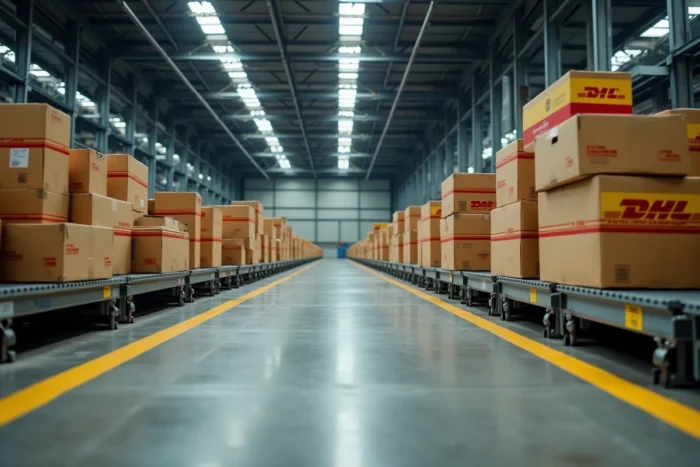
DHL Express France Delivery Times: What Changes During a Strike
Under normal circumstances, DHL Express offers delivery times calibrated between one and three working days for mainland France. A strike multiplies these times by two to three, sometimes more for rural areas served at the end of the chain.
Parcel tracking becomes unreliable during the conflict. Tracking updates cease or display frozen statuses (“in processing”), causing confusion for both senders and recipients. DHL recommends contacting customer service, but response times explode in parallel.
Most Affected Segments on the Territory
- B2C e-commerce shipments, often routed via DHL eCommerce rather than DHL Express, experience the longest delays as they do not benefit from the sorting priority granted to Express contracts
- Domestic palletized freight (DHL Freight) can be redirected to other partner carriers, but with additional costs and rescheduling delays of several days
- Shipments to overseas territories, already dependent on limited air connections, accumulate delays without a rapid recovery mechanism
Companies that regularly ship volumes via DHL sometimes have contractual clauses providing for compensation or priority rerouting. Individuals and small e-commerce merchants do not have this leverage.
Impact on International Shipments and Tense Corridors
International flows to France remain under pressure long after the end of a local strike. The DHL network relies on fine synchronization between global hubs. A blockage in France disrupts connections in Leipzig, Cincinnati, or Hong Kong, and lost slots are not instantly recovered.
The situation becomes even more complicated when the DHL strike coincides with other European logistical disruptions. Market analyses show that major ports like Antwerp-Bruges and Hamburg experienced significant increases in container dwell times in 2024, which sustainably impacts the reliability of delivery times even outside strike periods.
New European Customs Regulation as of July 1, 2026
An additional factor has been added since July 2026: international shipments up to 150 euros no longer benefit from automatic duty exemption. This regulatory change imposes additional declaration formalities on small parcels, exactly the type of shipments that DHL eCommerce handles in bulk.
During a strike, these additional formalities create an administrative bottleneck that adds to the physical blockage. We recommend regular shippers verify the compliance of their declarations in advance to avoid a double delay (social and customs).

Alternatives and Trade-offs for Professional Shippers
Shifting all volumes to another carrier during a DHL strike is neither simple nor always relevant. The capacities of Chronopost, UPS, or FedEx are not extensible on demand, and these operators themselves experience an influx of redirected volumes.
The most effective approach relies on a multi-carrier strategy configured in advance, not in reaction to a social conflict. Companies that have integrated multiple logistics connectors into their information system can automatically route shipments to the available carrier according to priority rules (time, cost, geographical area).
- For urgent express shipments, UPS and FedEx offer comparable services but with additional costs during peak periods, as they absorb redirected DHL volumes
- For standard e-commerce, Colissimo and Mondial Relay are viable alternatives in France, with slightly longer delivery times but reliable coverage
- For international freight, using independent freight forwarders allows bypassing dependence on a single integrator, at the cost of heavier administrative management
Anticipation remains the only truly effective lever. Periods of social risk (end of year, sectoral wage negotiations) are identifiable. Building a buffer stock and diversifying transport contracts before a crisis is cheaper than managing the urgency once platforms are blocked.
The DHL strike in December 2024 reminded us that concentrating flows on a single operator exposes shippers to a binary risk: either the network operates, or everything stops. Companies that learned from this episode now work with at least two active carriers in parallel, which limits exposure without completely eliminating the risk of delay.