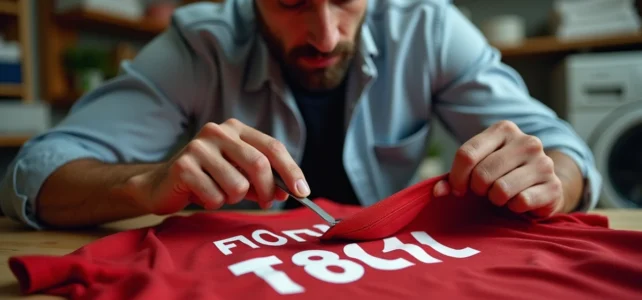
The heat transfer flocking on a football jersey is based on a polyurethane or PVC film bonded to the fabric with a hot melt adhesive. Removing this film without damaging the fibers of the jersey requires understanding the nature of this bond, not just heating and pulling. Here, we detail the approaches that actually work, distinguishing what preserves the technical polyester from what destroys it.
Behavior of technical polyester in response to heat and solvents
Modern football jerseys use a microfiber polyester often treated with a water-repellent finish. This surface treatment is the first victim of poorly conducted deflocking. Acetone, still recommended on some forums, does dissolve the hot melt adhesive, but it also attacks the water-repellent treatments and can dull the fabric color within seconds of contact.
We recommend always testing the chosen solvent on a hidden area, typically the inside of a side seam, before applying it to the flocked area. Polyester tolerates no chlorinated solvents or concentrated acetone. Isopropyl alcohol remains the safest compromise among common solvents.
The softening temperature of the hot melt adhesive is within a range compatible with an iron set to synthetic. Beyond that, the polyester itself begins to deform. It’s a narrow margin, and the difference between cleanly removed flocking and a wrinkled fabric often comes down to a few degrees and a few seconds of exposure. To know precisely how to remove flocking from a football jersey without risk, one must master this thermal window.
Removing flocking with an iron: the technique that really works
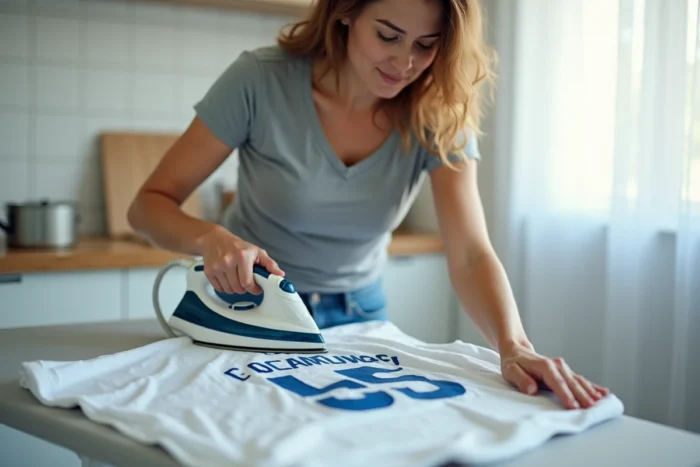
The thermal method remains the most reliable for removing flocking without leaving massive residue. The principle is simple: soften the adhesive, then peel off the film by slow pulling while it is still warm.
Materials and settings
- An iron set to synthetic, steam turned off. Moisture creates halos on the polyester and makes the adhesive harder to work with.
- Parchment paper (baking paper), never newspaper which can transfer ink onto the hot fabric.
- A flat tweezers or a plastic spatula to lift the edges of the flocking without scratching the fabric.
Step-by-step process
Lay the jersey flat, flocked side up, on a hard surface (not a soft ironing board that absorbs pressure). Place the parchment paper over the flocking and apply the iron without movement for a few seconds.
Remove the iron, lift the paper, and immediately start peeling the edge of the flocking with the tweezers. Pull slowly, at an angle close to 180 degrees (folding the film back on itself), never perpendicular to the fabric. A perpendicular pulling angle tears fibers.
If the film resists, replace the paper and heat again for a few seconds. Proceed letter by letter, number by number. Rushing is the main cause of damage.
Removing adhesive residue after deflocking
Once the film is removed, there is almost always a ghost of adhesive left on the fabric. This is the part that most tutorials rush through, yet it determines the final result.
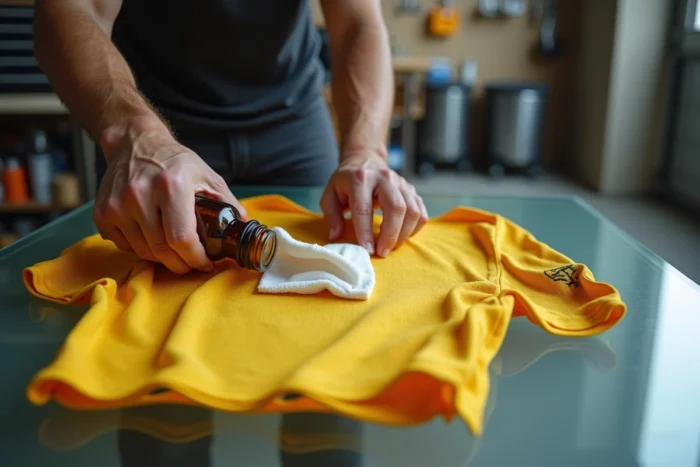
Isopropyl alcohol applied with a cotton swab is the safest method for dissolving these residues. Soak a cotton ball or a clean cloth, dab the sticky area without rubbing. Rubbing spreads the adhesive instead of dissolving it, and risks pilling the surface of the jersey.
Specialized deflocking products, formulated for sports textiles, have appeared in the French market in recent years. Offered by textile customization workshops, these gels or sprays position themselves as alternatives without aggressive solvents, compatible with technical polyester fibers. We do not have enough experience to objectively compare them to isopropyl alcohol, but their existence is worth noting for collectible jerseys where the value justifies an additional investment.
After treatment, wash the jersey in cold water, by hand, to remove any chemical residue. Immediate machine washing, especially in hot water, risks setting any remaining adhesive marks.
PVC, flex, and sublimation flocking: each type reacts differently
Not all flocking is removed the same way. A heat transfer flex flocking (smooth and shiny film) generally peels off well with heat. A velvet flocking (PVC flocked) is thicker and often requires multiple heating passes.
Sublimation, on the other hand, does not come off at all. A sublimation marking is integrated into the fiber, not glued on top. The ink migrated into the polyester during high-temperature transfer. No solvent or mechanical method can erase it without destroying the fabric. If your jersey is sublimated, the only realistic option is to entrust the work to a textile professional who may be able to cover the marking.
To identify the type of flocking, lightly scratch a corner with your nail. A heat transfer film lifts, forming a thin layer. A sublimated marking has no perceptible thickness; the pattern seems to be part of the fabric itself.
Common mistakes that damage the jersey during deflocking
Some common actions cause irreversible damage to a football jersey:
- Using a hairdryer on concentrated mode too close to the fabric. The heat is unevenly distributed and creates hot spots that locally deform the polyester.
- Scraping off residual adhesive with a blade or cutter. Even on a surface that seems thick, the blade cuts into the fibers and creates fragile areas visible in the next wash.
- Soaking the jersey in hot water mixed with white vinegar. This method, popular online, does not sufficiently soften the hot melt adhesive and risks especially discoloring bright colors, notably red and blue.
- Ironing directly on the flocking without protective paper. The film melts and adheres to the soleplate of the iron, tearing pieces of fabric in the process.
A properly deflocked jersey can be reflocked or worn as is. The condition is to have respected the compatibility between the chosen method and the type of marking. On a vintage or collectible jersey, the doubt should always favor caution: better a damaged flocking than a destroyed fabric.