
The French market for online scheduling is fragmented: dozens of solutions coexist, with business models ranging from fixed subscriptions to commissions on each booking. In this context, choosing an appointment management tool comes down to balancing very concrete criteria, from the actual monthly cost to the ability to reduce incoming phone calls. This article compares measurable differentiation axes to identify what produces a tangible operational gain.
Fixed subscription or commission per booking: which model is cheaper
The distinction between a fixed monthly subscription and a commission per online appointment is rarely clearly stated in comparisons. However, it changes the bill as the volume of bookings increases.
| Business Model | Predictable Cost | Impact at High Volume | Suitable for |
|---|---|---|---|
| Fixed Subscription | Yes, stable amount each month | Unit cost per appointment decreases | Professionals with regular flow |
| Commission per Booking | No, varies by activity | Total cost increases proportionally | Low or seasonal volume activities |
For a professional who sees several dozen clients per week, the fixed subscription becomes mechanically cheaper than the commission. On the other hand, a highly seasonal activity with few slots booked outside peak periods may find value in the commission model, as it pays nothing during slow months.
When browsing the services offered by RDV Pro, it is clear that the logic is that of an all-in-one tool with no commission on transactions, placing the solution in the fixed subscription category. This positioning favors budget clarity.
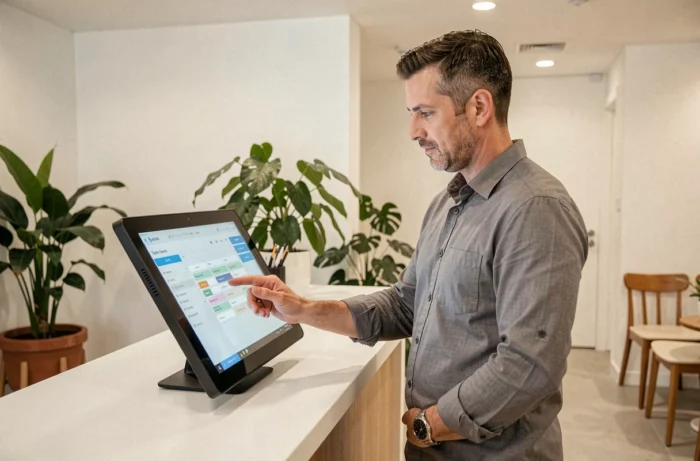
Shifting phone calls to the online calendar: a measurable organizational effect
Pages for online appointment software mention “time savings” without specifying where it occurs. The most documented impact concerns the decrease in incoming calls after activating a 24/7 booking page.
In hair and beauty salons, the opening of an online calendar accessible at all times leads to a gradual shift: clients book their own slots instead of calling. The reception work becomes simpler because staff no longer interrupt a service to answer the phone.
This trend is described as structural, not just an add-on. Once the majority of clients get used to booking online, the flow of calls does not return to previous levels. The gain consolidates over time.
What accelerates or slows the shift
- The visibility of the booking link: a QR code in the window or a button on the Google listing accelerates adoption by clients who call out of habit
- The simplicity of the customer journey: if the booking page requires creating an account or imposes too many steps, some clients revert to calling
- Automatic reminders via SMS or email: they reduce no-shows and strengthen the client’s trust in the online system, encouraging them to reuse the tool
Automation of reminders and reduction of absences: concrete mechanisms
Automatic reminders (email, SMS) sent before each appointment are the most direct lever against unnotified absences. The reminder acts as a safety net: the client who forgot their slot can cancel or reschedule instead of simply not showing up.
Online payment at the time of booking reinforces this effect. When a deposit is required, the client has a financial commitment that reduces the likelihood of absence. The combination of both mechanisms, automatic reminders and deposits, produces a significantly better result than each taken in isolation.
Scheduling and calendar synchronization
Appointment management software that syncs with Google Calendar or a third-party calendar avoids double bookings. This point may seem basic, but duplicates remain the primary source of error in multi-practitioner structures. Bidirectional synchronization, where each modification in one calendar reflects in the other, eliminates this risk without manual intervention.
For companies with multiple employees, role management (who can modify what, who sees which schedule) structures internal operations. Limited access for reception staff and full access for the manager prevent accidental changes.

GDPR compliance and hosting of customer data in France
The collection of personal data (name, phone, email, appointment history) by a SaaS software requires compliance with GDPR. Hosting data in France simplifies compliance because it avoids transfers outside the European Union, which require additional legal guarantees.
A technical point often overlooked: the hosting subcontractor is as important as the software publisher. If the publisher is French but stores data with an American provider, the legal framework for transatlantic transfer applies. Checking the actual location of the servers, not just the company’s headquarters, remains best practice.
For regulated professions (health, legal), GDPR compliance is not a marketing bonus. It is an obligation whose non-compliance exposes one to sanctions. Therefore, the choice of an online scheduling tool must integrate this criterion from the outset, not as a check afterward.
The choice of appointment scheduling software hinges on verifiable criteria: pricing model, data location, anti-no-show mechanisms. The shift from phone calls to online booking remains the most reliable marker of a real operational gain, as it structurally frees up time rather than just temporarily.