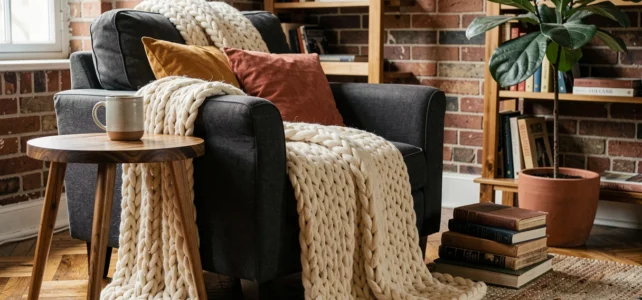
A comfortable sofa, soft lighting, a few warm textures: transforming your home into a cozy space relies less on a decor budget and more on specific choices regarding materials, lighting, and layout. However, in 2025, interior comfort is no longer just about stacking cushions. It now intersects with thermal and regulatory issues that change the way we think about the ambiance of a room.
Summer comfort and cozy ambiance: the link that decor ignores
Have you ever noticed that a pleasant living room in winter can become stifling in July? Most decor articles treat cozy as a winter topic. The problem is that an interior designed solely for the cold season (thick throws, heavy curtains, long-pile rugs) turns into a sauna at the first hint of warmth.
Since 2024, the overhaul of MaPrimeRénov’ explicitly includes summer comfort as a funding criterion. Fixed air circulators and solar protections for glazed walls (external blinds, shutters, awnings) are eligible for funding in the supported pathway. These installations modify the perceived temperature without air conditioning, and they directly influence the atmosphere of a living space.
An external fabric awning or a wooden canopy filters light while adding visual texture to the living room or terrace. A well-chosen ceiling air circulator becomes a full-fledged decorative element. Combining thermal protection and cozy aesthetics prevents the need to change everything between seasons.
To delve deeper into these interior design topics, Brico Déco Jardin’s home tips cover both renovation and everyday decoration.
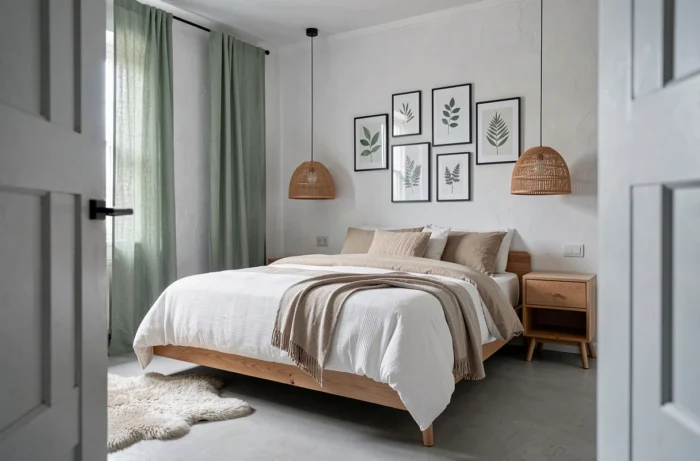
Soft lighting in the living room: choose sources, not watts
Lighting is the most underestimated lever for creating a cozy ambiance. One mistake is enough to ruin everything: a single white ceiling light. Even with a perfectly decorated interior, cold and central lighting cancels out the desired effect.
Multiply light points rather than power
The principle is simple. Three low-intensity lamps, distributed at different heights in the room, create a more enveloping atmosphere than a single powerful fixture. Specifically, combine a reading lamp near the sofa, a string of lights along a shelf, and a table lamp on a low piece of furniture.
Opt for bulbs below 3,000 kelvins to achieve warm light, leaning towards amber yellow. Bulbs labeled “warm white” indicate this on their packaging. Above 4,000 kelvins, the light turns bluish white, typical of offices.
Candles remain unbeatable
No light fixture exactly replicates the movement of a flame. Candles add an extra sensory dimension with their slight flickering light and, if scented, a fragrant signature. Place two or three on a wooden or metal tray to visually structure the whole.
Materials and textures: the rule of three layers
Have you ever flipped through a decor magazine wondering why a photographed living room looks so inviting while yours, although similarly furnished, seems flat? The answer often lies in the layering of textures.
A cozy space relies on at least three different textile layers in the same area. For example, on a sofa: the fabric of the upholstery (linen, corduroy), a knit or wool throw, and a cushion in a contrasting material (faux fur, textured cotton). This accumulation creates visual and tactile depth.
Here are material combinations that work particularly well:
- Washed linen and boucle wool: linen brings lightness, while wool adds density. The combination works year-round.
- Velvet and rattan: the contrast between a smooth, shiny surface and a raw woven material adds dimension to a living room or bedroom.
- Thick cotton and matte ceramics: on a coffee table, a cotton runner under ceramic objects creates a rustic yet contemporary effect.
However, avoid matching everything in the same shade and material. Cozy arises from controlled contrast, not uniformity.
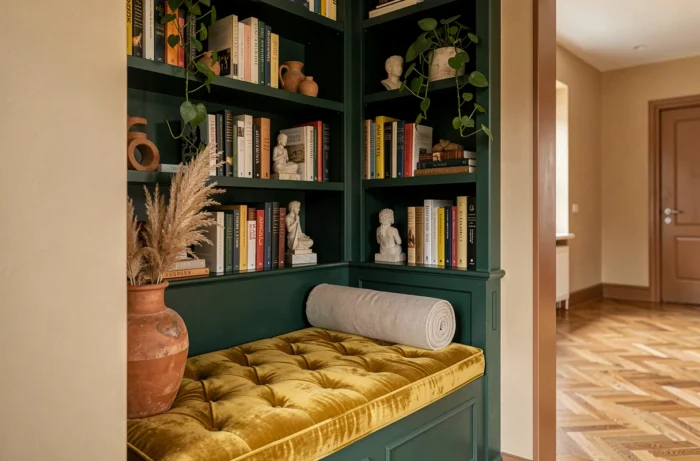
Cozy room layout: create zones without partitioning
In a living room open to the kitchen or dining area, comfort comes from the ability to delineate spaces without putting up walls. This is known as flexible zoning.
The rug as an invisible boundary
A rug placed under the sofa and coffee table visually defines the relaxation area. Choose one large enough for the front legs of the sofa to rest on. If it’s too small, it floats in the middle of the room and has the opposite effect.
Low furniture and open bookshelves
A low piece of furniture (buffet, console, bench) placed perpendicular to the wall separates two areas without cutting off light or sight. An open bookshelf, without a back, serves the same purpose while providing storage. These soft separations make each area of the room more intimate and functional.
Also consider the seating height. A pouf or floor cushion, lower than a classic armchair, changes the perception of volume. You feel more enveloped when sitting closer to the ground, surrounded by textiles.
Colors for a warm interior: beyond beige
Neutral tones (beige, ecru, greige) dominate cozy inspirations on social media. They work, but they are not the only option. Terracotta, sage green, and deep petrol blue create equally enveloping atmospheres, with more character.
The principle to remember: a strong color on a single wall is enough to anchor the atmosphere of a room. The other three walls remain in a light tone. This approach avoids a cave-like effect while adding visual warmth.
On furniture and accessories, stay consistent with the chosen palette, but allow for one or two standout elements. A mustard cushion in a living room dominated by sage green, for example, creates a focal point that draws the eye and energizes the whole.
Transforming a house into a cozy and trendy space ultimately relies on precise decisions: layering materials, fragmenting light, delineating living areas, and choosing colors with intention. Trends come and go, but an interior where one feels good always rests on these same technical fundamentals.