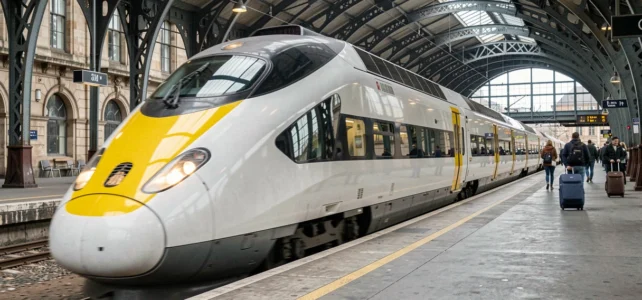
Paris Gare du Nord, a Tuesday morning: we pass through security and border controls in about thirty minutes, then we head to London without any air stopovers, without terminal transfers. The Eurostar network now connects several European capitals by high-speed train, but actual travel times and the stations served vary depending on the line, the period, and ongoing works.
Understanding the Eurostar map and travel times before booking avoids unpleasant surprises, especially when disruptions extend the journey by several tens of minutes. To visualize the lines and estimate travel times, consulting the Eurostar route map and travel times allows for precise itinerary planning.
Works and disruptions: actual Eurostar travel times
The official pages display theoretical travel times. On the ground, it can sometimes be different. Between August 6 and 23, 2026, engineering works on the high-speed line between Brussels and France will temporarily extend Eurostar and TGV INOUI journeys, without a total interruption of the line.
Specifically, this means that a Paris-Brussels trip announced in just over an hour may take significantly longer during this window. Checking disruption bulletins before each booking becomes a habit to adopt, not a detail for anxious travelers.
This type of temporary extension also affects connections. If planning a Brussels-Amsterdam or an indirect journey via Lille, a tight connection margin may be missed. Returns vary on this point: some travelers have only noticed a few minutes of delay, while others have missed their connections during similar work periods.

Direct Eurostar lines: served stations and travel times
The Eurostar network revolves around a few main routes departing from Paris Gare du Nord. Here are the direct connections and their reference durations (excluding disruptions):
- Paris-London (St Pancras International): the fastest journeys take about 2 hours and 16 minutes, with possible stops in Lille or Calais-Fréthun that extend the journey
- Paris-Brussels (Midi/Zuid): short connection, around one and a half hours direct, often used as a connection point to Amsterdam or Cologne
- Paris-Amsterdam (Centraal): direct journey available, which takes significantly longer than a Paris-Brussels due to the distance and possible intermediate stops in Rotterdam
- London-Brussels: about 2 hours of direct travel, with the same crossing of the Channel Tunnel as the Paris-London line
Frequencies vary by season. During peak times, the Paris-London line can offer numerous daily round trips. In off-peak periods, the options are reduced.
Intermediate stations and seasonal stops
Lille Europe and Calais-Fréthun serve as intermediate stations on the Paris-London axis. They also allow travelers to take the Eurostar without going through Paris, which is of interest to travelers from northern France.
In winter, Eurostar offers seasonal connections to ski resorts in the French Alps (Eurostar Snow service), with dedicated stops. This service operates for a limited period and is not listed on the map year-round.
Extension to Antwerp: what the addition of a direct stop in 2026 changes
Eurostar is preparing to add Antwerp as a direct stop on the London-Amsterdam route, with service expected to start from December 14, 2026. This is not a new standalone line: Antwerp fits into the existing route between London and Amsterdam.
For travelers, this opens direct access to Flemish Belgium without a connection in Brussels. Antwerp becomes the fifth major Belgian or Dutch city accessible without a train change from London.
The addition of a stop on an existing line slightly modifies the overall travel times. A London-Amsterdam journey with a stop in Antwerp will take a few minutes longer than a direct one. This will need to be monitored when the schedules are updated at the end of 2026.
Border controls and EES system: impact on real travel time
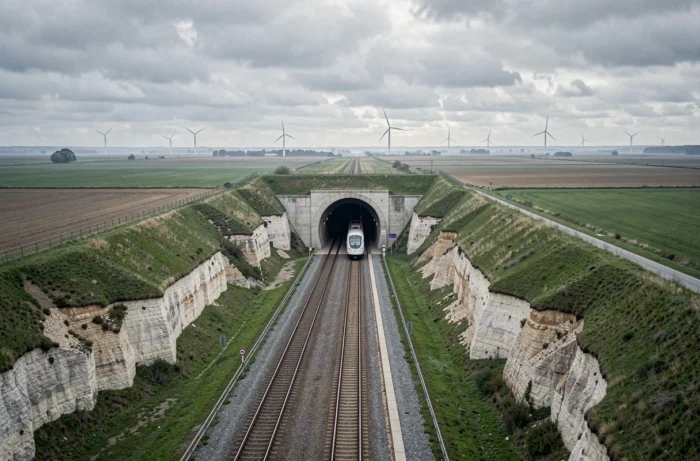
The Eurostar travel time is not limited to what happens on board. Border controls before boarding add significant duration to the total journey, especially on cross-Channel routes.
In 2026, EES (Entry/Exit System) biometric checks for non-EU travelers are still pending full deployment on certain Eurostar flows. Not all biometric kiosks are yet operational, which maintains a transitional regime this summer.
Arriving early: how much time to allow
Eurostar recommends arriving at the station well before departure. In practice, it is advised:
- At least 45 minutes to an hour before departure for a standard journey from Paris or London
- More time during school holidays or extended weekends, when the control lines lengthen
- Extra time if traveling with children, bulky luggage, or if needing to collect a ticket at the counter
The door-to-door journey includes control time, and this is often the factor that tips the train-plane comparison in favor of one or the other. On a Paris-London trip, the time spent at the station before boarding remains significantly less than the airport-check-in-security-boarding circuit.
With the extension to Antwerp planned for late 2026, the evolution of the EES system, and occasional works on the high-speed network, the Eurostar map is not fixed. Consulting updated schedules and disruption bulletins a few days before departure remains the most useful action to estimate actual travel duration.