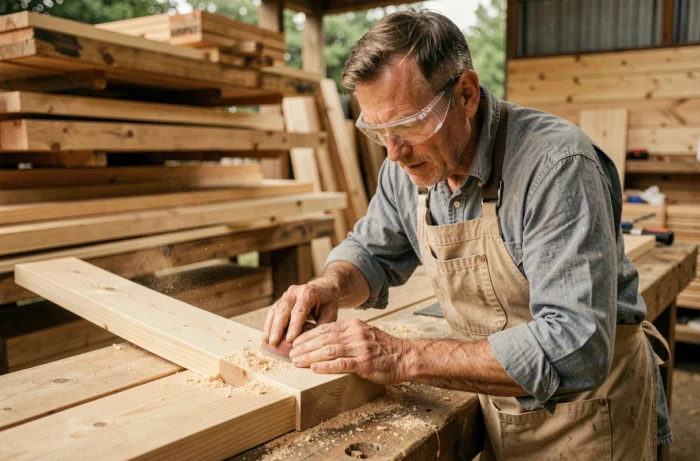
Wood remains the reference material for designing an outdoor space, but supply conditions, installation standards, and maintenance requirements have significantly evolved over the past two years. Between the trade restrictions on certain exotic species and the new maintenance recommendations, a custom wood project is no longer conceived in the same way as in 2023.
Ipé and Exotic Species: What CITES Registration Changes for Wood Decks
Since November 25, 2024, species of the genus Handroanthus (ipé) have been listed in Annex II of CITES. This listing means that each imported batch must now be accompanied by an export permit issued by the country of origin, certifying that the harvesting does not harm the survival of the species.
For an individual ordering an ipé deck, the direct consequence concerns traceability. The supplier must be able to present the sourcing documents. Delivery times are extending, and availability fluctuates more than before.
Artisans like Bois & Jardin 42 guide their clients towards alternative species, often European or from certified supply chains, which offer a more predictable durability-cost ratio. Black locust (false acacia), thermally treated oak, or class 4 autoclaved pine cover most outdoor uses without relying on a constrained import circuit.
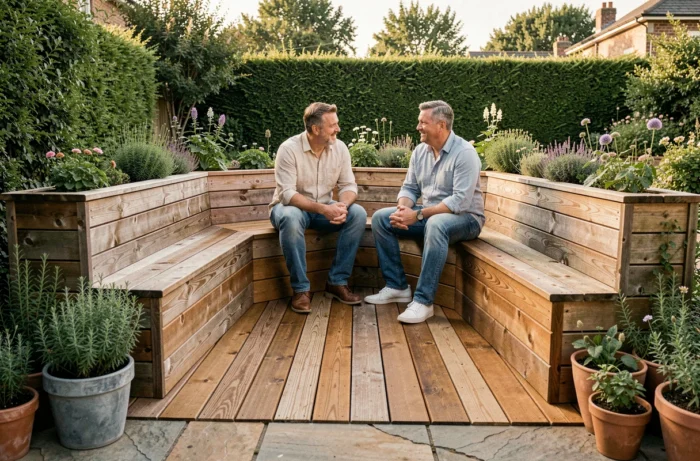
Wood Deck Installation in Wet Areas: Ignored Technical Constraints
Field feedback varies on this point, but the technical guides published in 2025 and 2026 converge towards a strengthened requirement: strictly separate the wood from the ground with a ventilated and draining structure. Installing joists directly on a concrete slab without ventilation space remains a common mistake, even among some occasional installers.
Ventilation and Adjustable Supports
The height of supports must allow for air circulation under the decking. In wet areas (near pools, clay soil, high water table), current recommendations emphasize checking the moisture of the substrate before any treatment or oiling. Applying a saturator on wood with a moisture content exceeding the manufacturer’s recommended threshold compromises product adhesion and accelerates graying.
Fastenings: An Underestimated Control Point
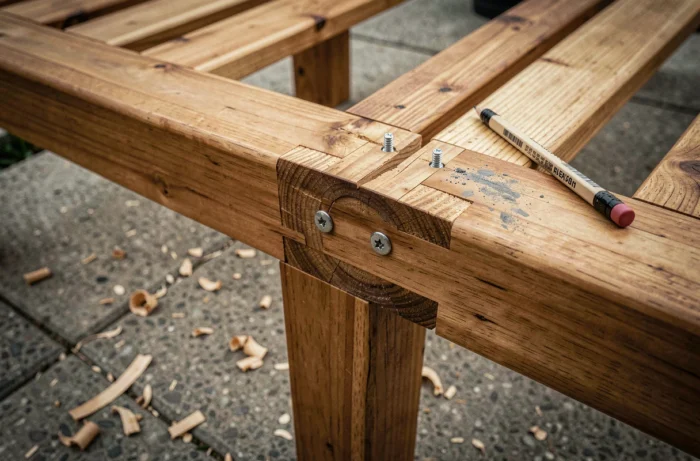
Several recent guides recommend systematically checking fastenings (stainless steel screws, clips) during each seasonal maintenance. A loose screw creates play between the board and the joist, encourages water accumulation, and accelerates localized degradation. Rigorous seasonal maintenance goes beyond simple cleaning with soapy water: it includes tightening fastenings, visually inspecting support points, and checking water drainage.
Custom Wood Furniture and Structures: Balancing Durability and Aesthetics
Pergola, carport, fence, garden furniture: custom wood allows for adapting each element to the exact configuration of the land. The available data do not allow for concluding that one species surpasses all others in every context, as the choice depends on exposure, local climate, and intended use.
Some concrete criteria help in making decisions:
- The wood’s use class (from 1 to 5) determines its resistance to moisture. For outdoor use in contact with the ground, a minimum class 4 is required. Class 3 wood is suitable for covered furniture or a sheltered pergola.
- Thermal treatment alters the wood’s cellular structure without chemical additives, improving dimensional stability. However, it slightly reduces mechanical resistance, a factor to consider for load-bearing structures.
- The choice between solid wood and glued laminated timber influences the possible span of beams. For a wide pergola, glued laminated timber offers superior rigidity at the same cross-section.
- The aesthetic appearance of wood evolves over time: natural graying is not degradation but a superficial color change. Whether to retain or prevent it is an aesthetic choice, not a technical obligation.
Hedges and Wooden Fences: The New Regulatory Regime for Hedges
The legal framework applicable to hedges evolved in 2026 with the publication of a decree in August, following the March 2025 law establishing a unified hedge regime. This text simplifies procedures but also introduces new distinctions.
Hedges integrated into the enclosure of a dwelling may be excluded from this regime, while hedges on bare plots or unfenced land are more directly subject to it. For an outdoor development project combining wooden fencing and a plant hedge, the legal qualification of the hedge determines the declarative obligations.
This point deserves to be verified in advance with the town hall or legal counsel, as field feedback shows that the local application of the decree varies by municipality. A project for a wooden fence adjacent to an existing hedge may require a simple declaration or no formalities, depending on the configuration.
Maintenance of Outdoor Wood: What Recent Guides Have Changed
Maintenance recommendations have become more precise since 2025. The generic advice “apply a saturator once a year” has been replaced by a more structured protocol:
- Mechanical cleaning (brush, never high-pressure cleaning unless respecting maximum distance and pressure) to eliminate moss and deposits.
- Checking the moisture of the wood using a contact hygrometer before any product application. Treating wood that is too moist renders the product ineffective and may trap water in the fibers.
- Inspection of fastenings and wood-metal contact points, where galvanic corrosion can occur if screws are not stainless steel.
This more demanding approach significantly increases the longevity of wood installations, provided it is planned from the project’s design stage. A seasonal maintenance schedule, integrated into the initial quote by the installer, ensures nothing is forgotten.
Outdoor wood remains a living material whose behavior depends as much on the quality of the installation as on ongoing maintenance. Choosing a species suited to its environment, respecting ventilation constraints, and adopting a documented maintenance protocol are the three levers that separate a sustainable installation from a project that needs to be redone after a few years.