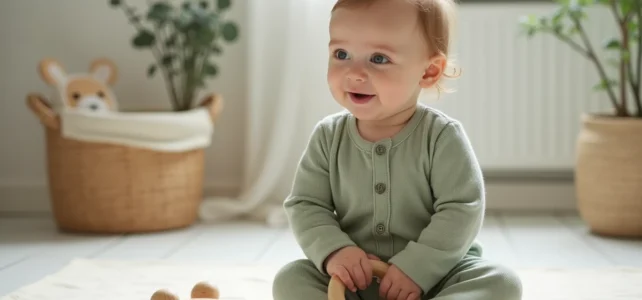
Baby fashion 2024 is structured around two measurable axes: the progression of unisex collections and the generalization of certified natural materials. Rather than listing seasonal styles, this article compares the concrete choices available to parents for dressing their child, intersecting market data and textile characteristics.
Textile materials for baby clothes: comfort and usage comparison
The choice of fabric determines both the child’s comfort and the durability of the piece. The 2024 collections converge towards three families of fibers, each with distinct properties.
| Material | Breathability | Softness to the touch | Preferred season | Care |
|---|---|---|---|---|
| Organic cotton | High | Very soft | All seasons | Machine wash, quick drying |
| Linen | Very high | Slightly textured | Spring-summer | Frequent ironing, creases easily |
| Merino wool | Moderate | Soft (no itching) | Autumn-winter | Delicate wash, flat drying |
| Recycled fabrics | Variable depending on the source fiber | Variable | All seasons | Similar to the original fiber |
Organic cotton remains the dominant fiber in baby collections in 2024, as it combines softness, ease of care, and compatibility with sensitive skin. Linen, valued for its thermoregulation in summer, requires more demanding care that limits its use to lightweight pieces (bodysuits, rompers).
Merino wool is gaining ground in autumn-winter sets. Its ability to regulate body temperature without excessive thickness makes it suitable for babies who are not yet walking and are often stationary in strollers. Parents looking for a balance between style and comfort for their child can find pieces made from natural materials designed for everyday use on https://lesbebesfringueurs.fr/.

Unisex baby fashion: what the gender-neutral trend reveals in 2024
According to Fortune Business Insights, gender-neutral clothing is a structuring trend in the global children’s clothing market. The growth is driven by parents’ demand for sustainable and shareable pieces between siblings.
This dynamic goes beyond simply choosing neutral colors. In 2024, baby ranges designed as unisex from the outset incorporate identical cuts for girls and boys, geometric or naturalistic patterns (foliage, stylized animals), and visual communication without gender markers.
Practical consequences for the wardrobe
A unisex collection reduces the number of pieces needed. A striped organic cotton bodysuit, an olive legging, and a round-necked sand-colored sweatshirt can be combined interchangeably. Fewer clothes purchased, more combinations possible: this is the principle of the mix-and-match capsules described by Trend Hunter in 2024.
On the other hand, gendered pieces (smocked dress, slim-fit jeans for boys) remain present in autumn-winter collections. They cater to occasional use (parties, photos) rather than everyday wear.
Mix-and-match capsules for babies: minimal wardrobe logic
Trend Hunter describes in 2024 the development of coordinated capsules for babies. The principle: a few striped and coordinated pieces allow for the creation of multiple outfits. This logic, borrowed from adult fashion, now structures collections for newborns and 0-24 months.
Typical composition of a baby capsule
- Three to four bodysuits in neutral tones (sand, mist gray, off-white) that serve as the base for each outfit
- Two leggings or soft pants in organic cotton, in compatible colors (olive, camel, mist blue)
- One to two sweatshirts or cardigans that are easy to put on, with snap buttons at the neck to simplify dressing
- One “statement” piece (animal print, discreet floral pattern, or color-block) that transforms the basic ensemble into a more dressed-up outfit
The total number of pieces hovers around ten to cover a full week. This approach reduces the clothing budget and the volume of laundry to manage, two criteria that weigh in the purchasing decisions of young parents.
Colors and prints for baby autumn-winter 2024: compared palettes
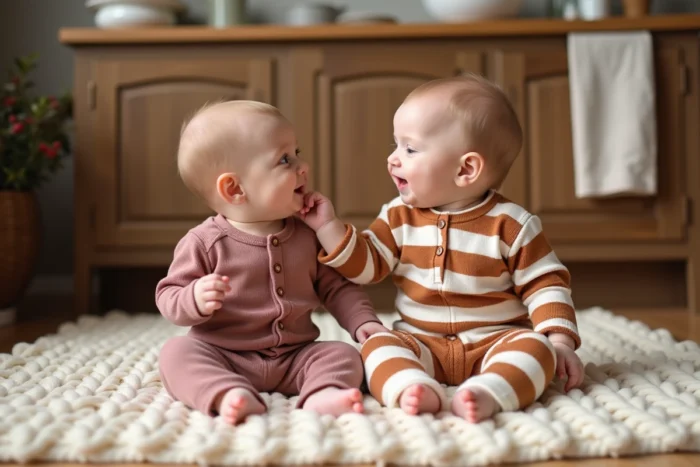
The dominant palettes of the season revolve around earthy tones and soft pastels. Sand, camel, olive, moss green, and mist blue are found in the majority of the collections reviewed. Lavender is incorporated as a touch of color in coordinated sets.
In contrast, bright colors and oversized graphic prints occupy a more limited niche. They appear in so-called “statement” pieces, worn as accents on a neutral base. Leopard print, for example, returns on accessories (bib, hats) rather than on main pieces.
Print and age: a choice that depends on mobility
For a baby under six months, discreet prints (fine stripes, polka dots) facilitate the matching of pieces with each other. From the age of walking, bolder patterns (animals, geometric shapes) visually withstand stains and wear better. The print then serves both a practical and aesthetic function.
Concrete selection criteria for everyday baby outfits
Beyond fashion trends, three technical criteria differentiate a suitable piece from a disappointing purchase.
- Closure systems: snap buttons at the crotch and collar facilitate diaper changes. Back zippers, which are more elegant, complicate daily dressing
- Fit: a baby garment that is too tight restricts movement. The 2024 collections favor slightly loose cuts, compatible with a diaper
- Textile certification: labels like GOTS or Oeko-Tex guarantee the absence of irritating substances, a point to check on each piece in direct contact with the skin
A well-designed baby garment is recognized by flat seams, which prevent friction on skin folds. This technical detail, rarely highlighted in product descriptions, makes a difference in wear.
Baby fashion 2024 boils down to a trade-off between a minimal wardrobe of natural fibers and occasional gendered pieces. The mix-and-match capsules address the two constraints that structure the market: limiting the number of clothes purchased while maintaining a variety of outfits. The fabric remains the primary sorting criterion, ahead of color or style.